She must find a boat and sail in it. No guarantee of shore. Only a conviction that what she wanted could exist, if she dared to find it.
Jeanette Winterson

Biscayne Bay, Florida
Linking with Kim Klassen’s Texture Tuesday.
Biscayne Bay, Florida
Linking with Kim Klassen’s Texture Tuesday.

I don’t know why…I just thought a photo of a manatee lying on its back drinking water might be considered unique…but I guess it all depends on what your normal is, right?

Visit my blog Two Salty Dogs for more on life on a sailboat in Florida. (Just click the pic.)
I normally live in Canada so I don’t see a lot of manatees. But when I’m living on a sailboat in Florida (like now) I tend to see them every once and a while.
Manatees take up residence primarily in Florida’s coastal waters during winter. They can also be found in the warm waters of shallow rivers, bays, and estuaries. Rarely do individuals venture into waters that are below 68 degrees Fahrenheit.
I love gentle creatures like elephants. Manatees are a large aquatic relative of the elephant and are very gentle too. They are slow moving and playful and have been known to body surf and barrel roll when playing.
Manatees are grayish brown in color and have thick, wrinkled skin on which there is often a growth of algae. Their front flippers help them steer or sometimes crawl through shallow water. They also have powerful flat tails that help propel them through the water. They are herbivores and they eat marine and freshwater plants.
Manatees only breathe through their nostrils, since while they are underwater their mouths are occupied with eating! A manatee’s lungs are 2/3 the length of its body.
The leading human-caused threat to Florida manatees is collisions with watercraft, mostly powerboats. Propellers and boat hulls inflict serious or mortal wounds, and you often see manatees with a pattern of scars on their backs or tails after surviving collisions with boats. Scientists believe that unless this cause of death is curtailed, the manatee population will not recover.
There is a great effort to educate boaters about the dangers they present to manatees and I can only hope the message is getting through…These gentle giants were here first and we must learn to share the water with them.

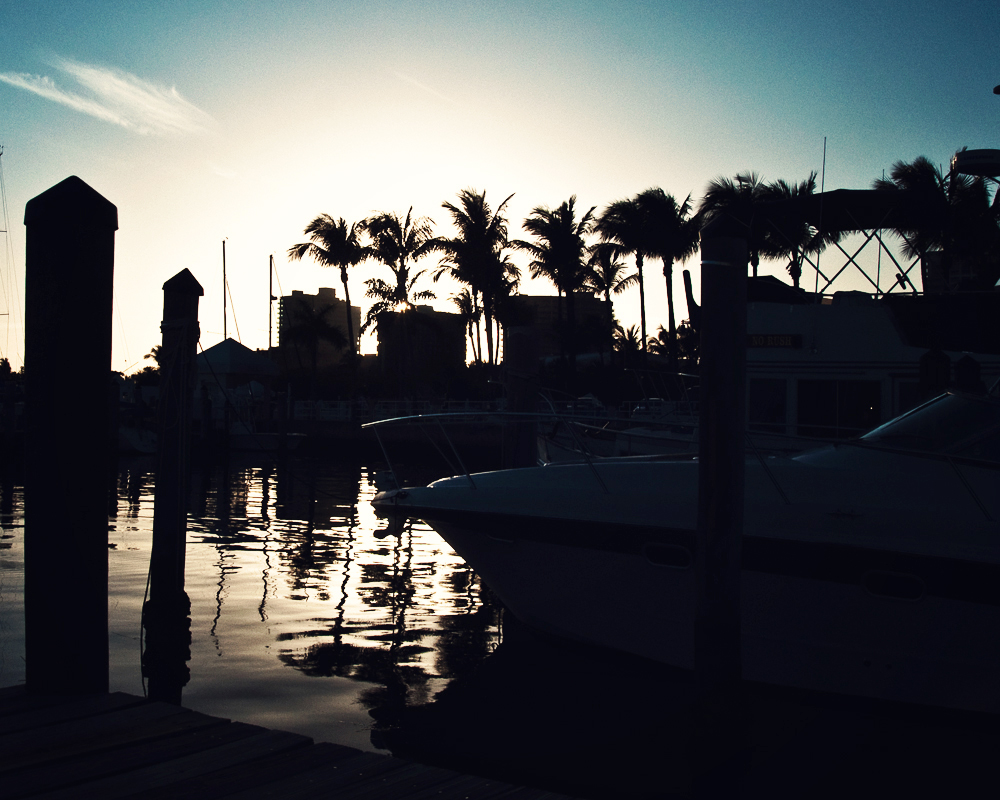
A view from the dock
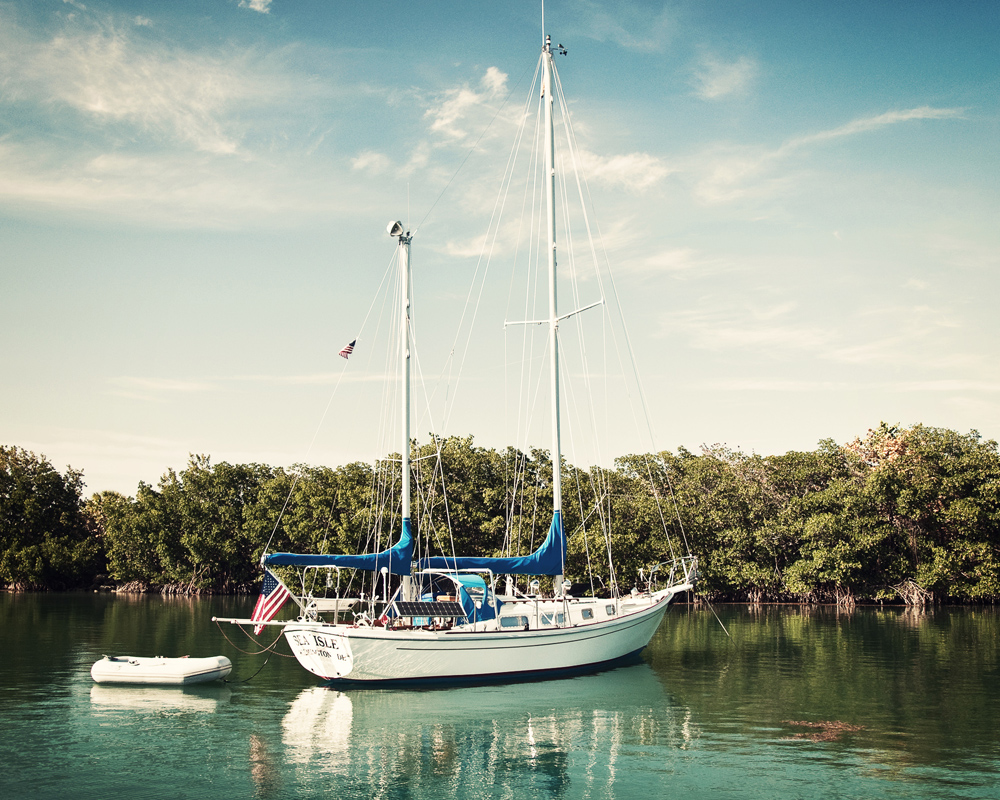
A view at anchor
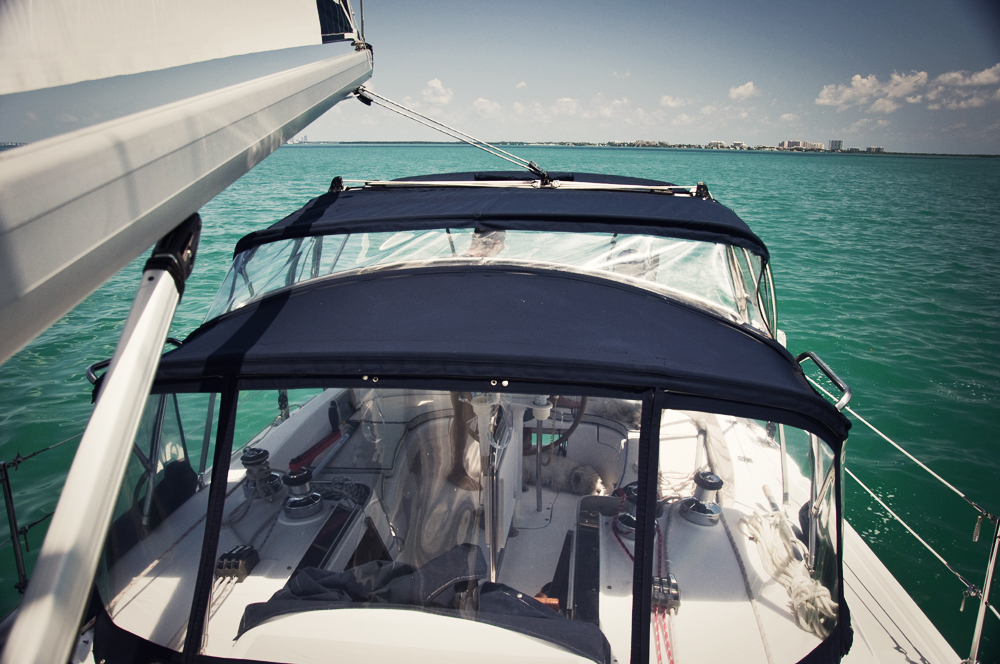
A view from the top of the sailboat, sailing
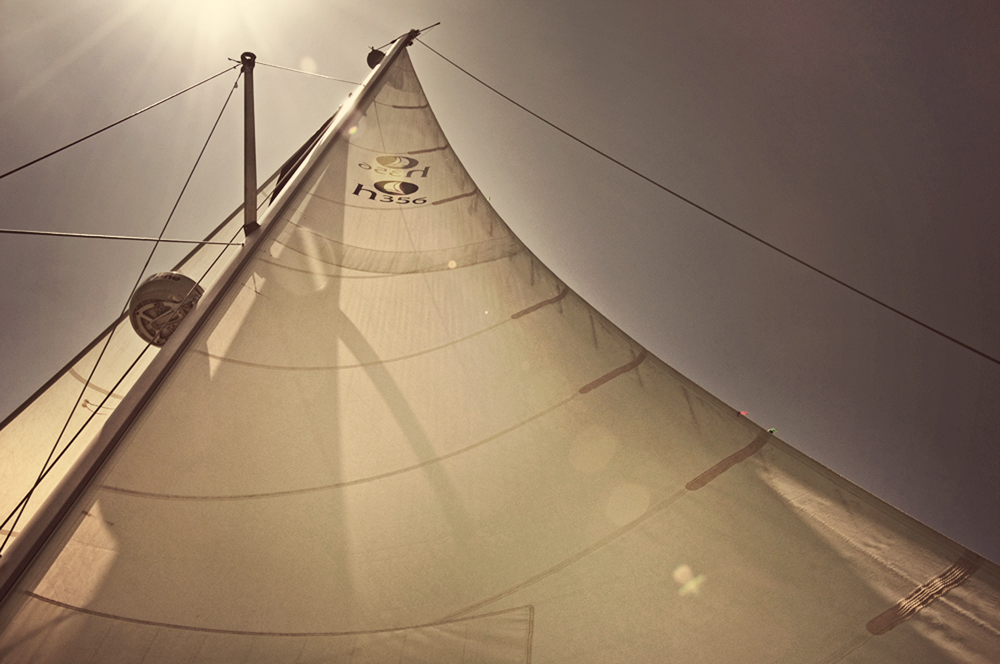
A view from the cockpit, sailing

A view from the cabin, sailing

A view of Sherry at the helm, sailing
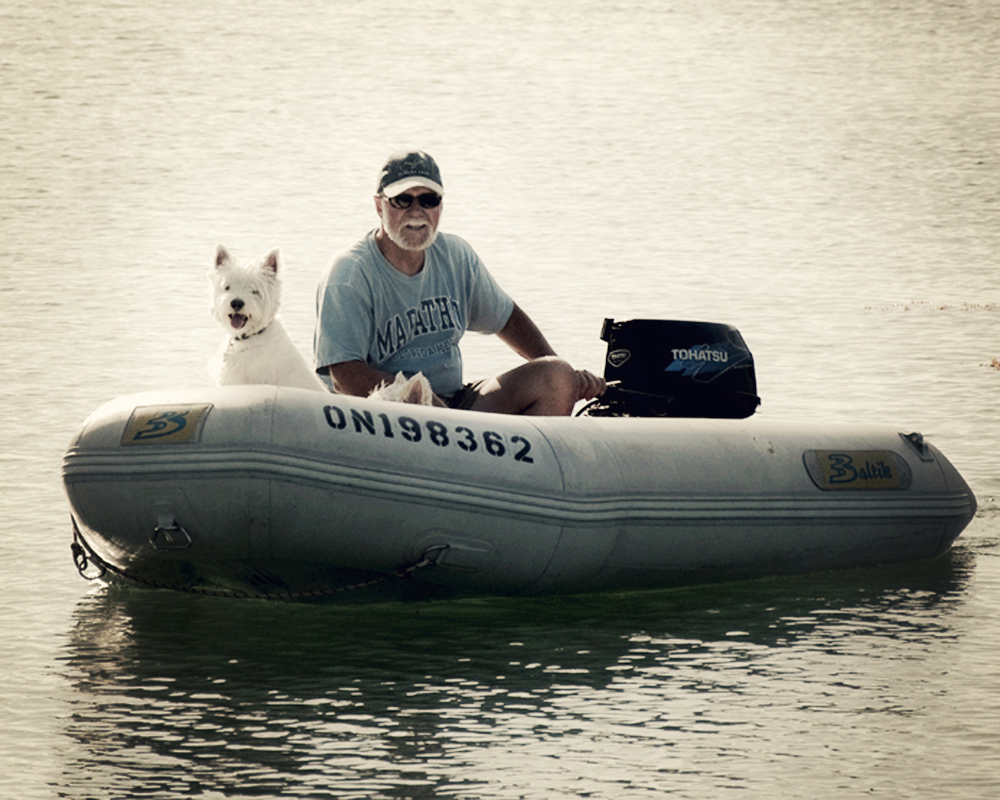
A view of Bob and the dogs in the dinghy


“Houston, we have a problem.”
These are not the first words you want to hear when you’re just waking up in an idyllic anchorage. We had had a perfect sail from Dinner Key to No Name Harbour on Key Biscayne the day before. That evening we had celebrated our anniversary with a dinner of grilled snapper, a pitcher of sangria and Key Lime pie (not as great as Joan’s, but it did in a pinch).
We sat on the balcony of the Cuban restaurant overlooking the anchorage and, as the sun set into the midnight blue water, we kept an eye on our boat and listened for sounds from Angus and Charles who were babysitting themselves that evening. All was quiet and still. I took advantage of the Wifi to have a brief Facebook catch up with my sister, Elena.
We chuckled as we recalled the antics of Angus or “Houdini dog” during our stop here two years ago. We had gone to the same restaurant for supper. Just as we were getting into the dinghy to motor back to our boat, Bob looked over at Windsong and saw something white and fuzzy sticking out of the top of the boat. “Is that Angus?”
And indeed it was. We couldn’t believe it. He had somehow managed to jump into the V berth, crawl on top of whatever was in there and pop his head out the hatch to look for us. Of course, he was younger then.
We have many fond memories of this anchorage, which is an easy walk to a beautiful beach and the Cape Florida lighthouse I so enjoy photographing. We were hoping to stay a few days this time. But it was not to be.
Bob had woken up before me and was checking the voltage of our batteries, which had been fine during the day, but low before we went to sleep.
Dead as doornails. Which meant no power to keep the fridge and freezer cold, no VHF radio and no juice to start the engine. There was no wind, so we could not sail anywhere. We were stuck. Not Gilligan’s Island stuck, but stuck.
We needed a boost or a tow, depending on the state of our batteries. This was a job for Boat U.S.! Figuring we should be prepared for such eventualities, we had purchased Boat U.S. insurance (CAA for boats) before we left Canada. Tows can be very expensive ($600 is not uncommon) so being insured is a no-brainer.
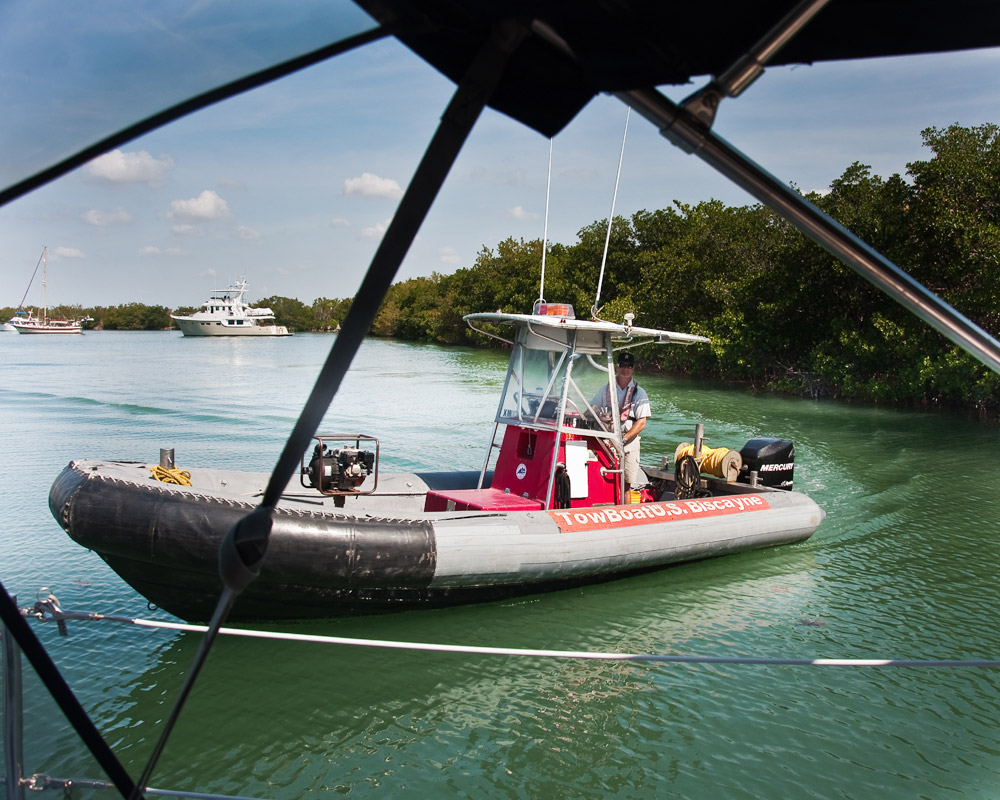
We didn’t hesitate to call Boat U.S., and, within 45 minutes, Matt showed up with his tow boat to rescue us. You could tell that he had done this many many times before and his professionalism certainly inspired confidence. First, we tried booster cables, but the batteries were totally fried. A tow it was to be. Matt tied us on to his boat with a line and proceeded to lead us back to Dinner Key.
We had called ahead for a slip and for docking assistance, and since we were familiar with the marina, we knew where to find Slip 46 on Pier 2. Entering the channel was not a problem. The tricky part was docking with no power. Once we got into the fairway, Matt moved from in front of us to beside us and pushed us into the slip from the starboard side.
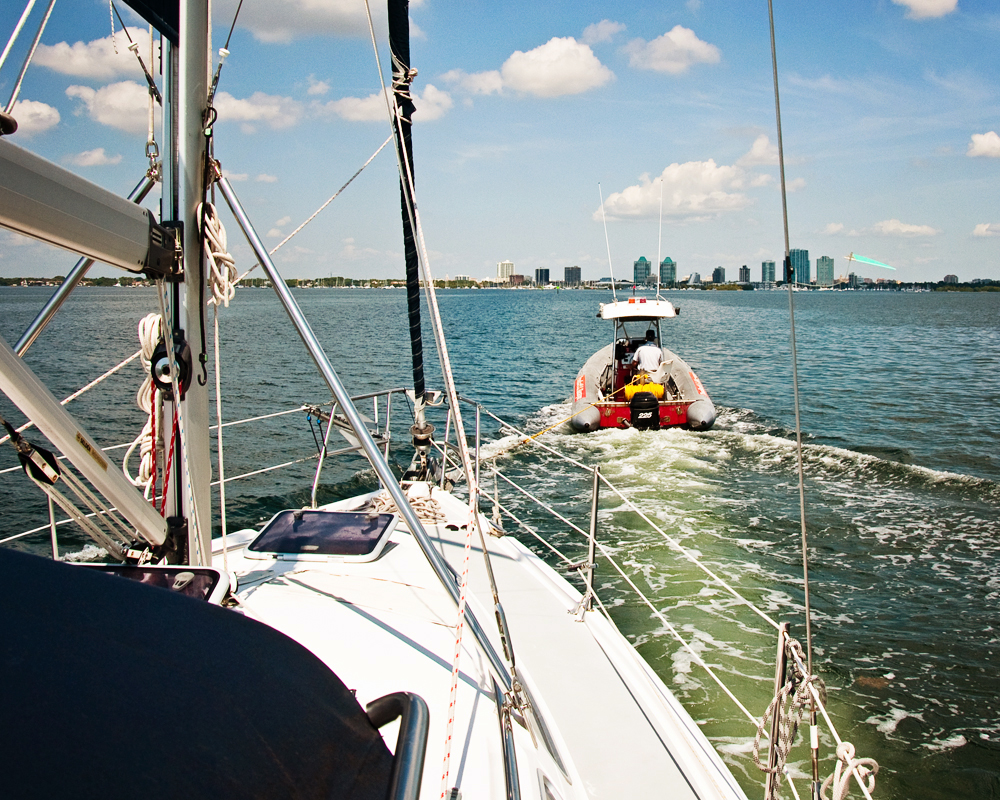
Bob steered the boat and I threw lines to our helper on the dock and fended off the sailboat to our starboard side as the bow of Windsong II veered in that direction. It was a bit hairy, but everyone pulled together and we docked without incident.
When we bought the boat, we knew the batteries were old, but we hoped they would last at least for this cruise, so we could replace them all next fall. And we had been using shore power to keep all our systems powered up. As it turns out, the batteries had nothing left to give, so we are now in the process of replacing them with fresh new batteries.
We’ve decided to go from three batteries to four batteries, which requires some additional wiring. So, all together the installation takes about a day and a half, and then we’ll be on our way again. Take 2!

We haven’t had easy access to the Internet lately so I haven’t put up as many posts as I was hoping to…Stay tuned for more on what we’re up to.
It’s time for a few pics of Biscayne Bay…We adore this body of water, with its shallow depths and beautiful colours.
In one direction, you can see Miami, in another Key Biscayne, and of course, Coconut Grove.
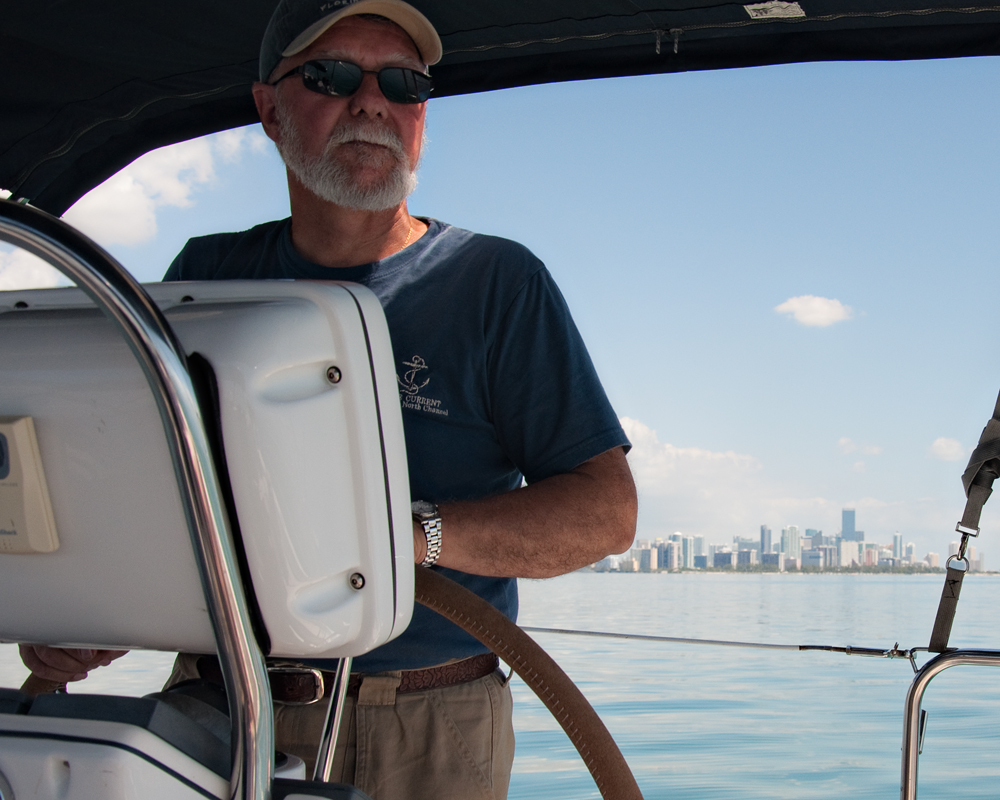
That's Miami in the background

Leaving Coconut Grove

The water was so still you could see the reflections of the clouds.

Looking toward Key Biscayne


First pic of Bob handling our new boat
Yesterday was our first opportunity to try close-quarters manoeuvring under power with our new boat. Bob had helped sail the boat from Fort Lauderdale, but we decided to wait to try moving it and docking it under power until we had an experienced hand with us.
A wise idea, I think. It is never a bad idea to get a little training when you’re dealing with a 14,000-pound vessel.
And while Bob has many years of experience on other boats, the situation here presents a range of new challenges. For one thing, this new boat is much bigger and heavier. If not properly controlled, it can do a lot more damage. It also has an inboard engine in contrast with our previous two sailboats, which had outboard motors that could be steered.
In addition, most slips in Florida have a very short finger dock with pilings at the end, a big change from the docks we’re used to at home, which are longer. We need to be able to back into this type of dock so that we can get the dogs on and off the boat easily and safely.
Sailboats have a well-deserved reputation for being very difficult to back into a slip. Not only do they have a small engine and propeller in relation to their large size, but they also have something that’s called “propwalk” that causes the back of the boat to veer sideways as soon as the boat is shifted into reverse. Lots to get used to.
So, being responsible boat owners, we contacted the Coconut Grove Sailing Club and asked them to suggest a trained instructor who would be willing to coach us on our boat. They linked us up with Bruce Penrod, a super-experienced instructor and boat captain, who offered to provide several hours of customized lessons. Bruce, a retired school teacher, has made many long single-handed voyages on his Hunter Legend. Originally from Pennsylvania, he and his wife now live in Miami. He also happens to be a yacht broker.
Bruce managed to instill confidence right away with his calm approach and solid tips. He reinforced that it was always best to take it slow. If a docking manoeuvre isn’t working out we should just abort it and start all over again. Better do it more than once than panic and botch it up.
He suggested that we first motor out of Dinner Key Marina into Biscayne Bay, where we could practise low-speed turns and stops and backing up in a straight line, without having to worry about being close to other boats. He wanted us to get a sense of how our boat performed and get familiar with its glide zone, for example. (The glide zone is the distance it takes the boat to stop when the forward thrust is turned off while advancing at the minimum speed to maintain steerage.)
After that, our plan was to spend some time practising backing into a slip at the club. Wouldn’t you know it, though, the skies — which had become pretty gray over Biscayne Bay — decided to open right at that moment. We got drenched! So we reverted to Plan B, which was to have a nice lunch at the Club and wait until the rain passed. It was a good thing that Bruce knows the entrance to the club like the back of his hand, being a member and having his own boat there, because visibility in the downpour was pretty bad. We tied up at the dock and Bruce proceeded to give us a tour of the club. (My camera battery died earlier in the day so I couldn’t take any pictures of it, sadly.) But trust me, the view from the restaurant balcony is just lovely.
When the rain stopped, we spent another half an hour practising docking at Coconut Grove. The main lesson here was learning how to deal with propwalk. In our boat, because of the direction the propeller rotates, the propwalk is always to port. So you have to learn how to plan for propwalk when backing in. This meant going a ways past the slip before starting to back in.
After that, we headed back to our slip at Dinner Key to finish up with further practice backing into our own slip. We also learned how to handle the lines in all different wind conditions.
Bob felt more confident than he expected to handling the boat and was pleased with the way it handled. Although it is three times heavier than Windsong, it was very responsive. Of course, this boat is much less affected by the wind than our smaller boats were, and it turns better. A lot of the boat-handling techniques used with the little Hunter seemed to work as well.
We lucked out in finding Bruce, who was a patient, calm and reassuring teacher, and a great communicator. We may work with him again on other aspects of sailing.

A sailor is an artist whose medium is the wind. Webb Chiles

I grabbed this shot of the Canadian team as they whooshed by our sailboat in the Dinner Key mooring field. It was taken two years ago on our last cruise from Stuart to the Florida Keys.
It was early and I had just woken up. I emerged bleary-eyed and caffeine-deprived from the cabin to the cockpit, thinking about pancakes. Its a good thing I was fully clothed though, because all of a sudden scores of racing dinghies surrounded us, and they were very, very close.
These skilled sailors — artists of the wind — sliced their way through the corridors between the moored sailboats at top speed without hitting anybody. They were heading out into Biscayne Bay to compete in the Star Class race of the Bacardi Cup during Miami Sailing Week, an annual event.
As they flew by, many called out good morning. I managed to regain my senses quickly enough to pick up my camera and get some shots while calling out to wish them good luck in the race (especially the Canadians!).
Memories of that day came flooding back when we heard that several of the tanned and strapping men that have been staying here at the Commodore Inn had won places in the Star Class race in this year’s cup.
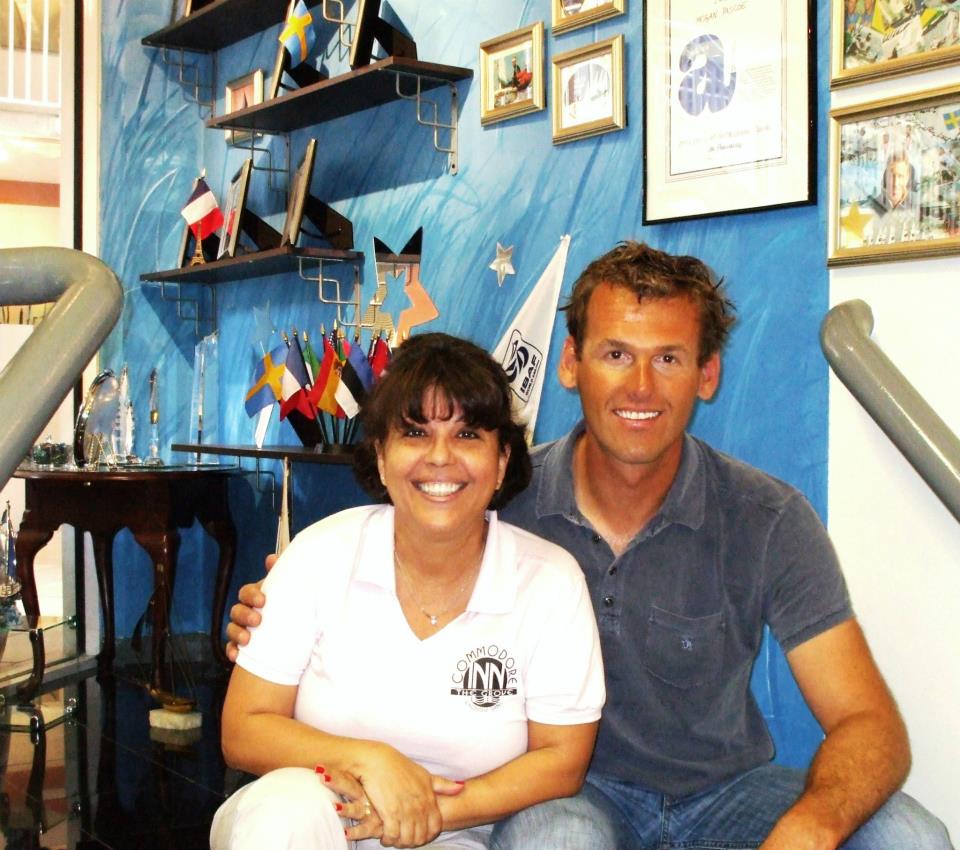
Here’s one of the winners Mateusz Kusznierewicz of Poland posing with Maggie, manager of the inn. She is a real sailing nut and a sponsor of most of the sailing regattas that occur every year from November through May. She maintains a hall of fame in her office with pictures of regatta participants and their trophies.

Here are winners Mateusz Kusznierewicz and Dominik Zycki of Poland in action taken by sailing photographer Onne van der Wal. What a shot!

 Sherrygaley.com