Artist profile: Diane Schuller

Now and again, I discover someone whose work makes my jaw drop and moves me profoundly. I decided to launch a series of occasional blog posts featuring such artists, for two main reasons. First, because this calibre of creative expression deserves to be shared and celebrated. And second, because I was curious to know more about them!

I’m kicking off the series with photographer Diane Schuller, who lives happily at the “hem of the sea” on Vancouver Island, British Columbia. Like many of us, Diane has been taking photos all her life. But some time around 2000, she started to get more serious about photography. As a freelance writer, she realized that images could enhance her articles.

How did she develop her skills? Partly from reading, partly from courses, but mostly from hands-on experimentation. Although Diane enjoys playing with post-processing, she’s not smitten with it, and prefers trying new things in camera.

She dedicated herself to portrait photography for several years, beginning with animals and pets, and also continued to do editorial work. (Her images of dogs are some of the most beautiful I’ve ever seen. You can see the love there.) She’s had her photos featured on magazine covers and she sells beautiful fine art prints. Upon moving to the west coast last year Diane put her business on hold and now devotes herself to making images for the pure joy of it. Her camera rarely leaves her side.

I delight in every new blog post of Diane’s; they make me feel as though I’m chatting over a honey-laced cup of tea, wrapped in a cashmere shawl, with a caring friend. I’m a huge fan of Diane’s visual style, which is pure and fresh and without artifice.I asked Diane to select some of her favorite images and tell me a bit about each of them.  And then she kindly agreed to answer a modified version of the Proust questionnaire, which is believed to reveal an individual’s true nature. I hope you’ll agree that reading her responses is a great way to get to know her better.

Diane’s ability to convey a deep sense of melancholy makes her first photo haunting. She deftly uses composition, framing, and post-processing choices to communicate emotions clearly and directly to her audience. She says this about her first image: Walking along the seawall on a vacation, I noticed this elderly gentleman walking towards me. He didn’t seem to want to engage in a “hello” and I could tell he was sad and also had something on his mind. I walked past him and when I looked back, I noticed he had stopped. I couldn’t help but pick up my camera and take this quiet image of him. I wanted to hug him, but didn’t. I’ve never stopped thinking about him.

What is your dream of happiness? Contentment in all forms; being content with what I have. 

What is your idea of misery? The death of a loved one.

Where would you like to live? Where I am right now, at long last, along the hem of the sea.

What qualities do you admire most in a man? Honesty, independence, sensitive enough to be willing to cry.

What qualities do you admire most in a woman? Honesty, kindness, sense of adventure.

What are your chief characteristics? People pleaser, highly observant, daydreamer.

What is your principal fault? Procrastinate far too much and lack patience.

What is your greatest extravagance? Wine and too much good food.

Diane says this about her image: I adore black and white images, always have. This just makes me feel so good.

What faults in others are you most tolerant of? Social inadequacies and tardiness.

What do you value most about your friends? Their acceptance.

What characteristic do you dislike most in others? Lying and excuse-making.

What characteristic do you dislike most in yourself?  My impatience.

What is your favourite virtue? Can’t say just one: being respectful, courage, honesty.

What is your favourite occupation? Well, that’s tough because there are things I’ve done I’ve loved and things I’d love to do but haven’t yet: photography of course, writing, and if I had it to do over again … I’d love to have a radio program where I interview a variety of people and I’ve often thought how interesting and challenging it would be to work in the medical field (emergency room nurse or occupational therapist perhaps).

What is your favourite colour?  All of them; but orange makes me very happy, and green fills me with calm.

Diane says this about her image: I love photographing food but the day I made these jars of marmalade was such a special day for me. I was thoroughly enjoying the process and not even minding all the fiddly work involved in making marmalade. I felt such a feeling of accomplishment and joy. This image depicts all of that for me.

What is your favourite flower?  So many, especially the fragrant ones: lilac, stargazer lilies, alyssum, Hansa roses.

Who are your favourite prose authors? So many and an eclectic bunch (forgive me if I don’t mention them all): Lisa Genova, Jane Urquhart, Anita Shreve, Alistair MacLeod, Andre Dubus III, Rohinton Mistry, Maeve Binchy, Rosamunde Pilcher, Tatiana de Rosnay.

Who are your favourite poets?  I just know I’ll forget some but let’s start with: Mary Oliver the most but also Carl Sandburg, Leonard Cohen, William Carlos William, Shel Silverstein, Kahlil Gibran. 

Who are your favourite heroes in fiction? Penelope Keeling in The Shell Seekers by Rosamunde Pilcher and Lily In The Secret Life of Bees.

Who are your heroes in real life?  My mother. She was strong, kinder than anyone I know, and she never ever complained despite all the obstacles she had to endure. For a public figure, Terry Fox was a true hero.

What natural talent would you most like to possess? Singing.

How do you want to die? I fear death, so quietly and in my sleep.

What do you consider your greatest accomplishment? Raising my son to be a gentle, responsible, loving man with very good manners.

What is your motto? Carpe diem (seize the day).
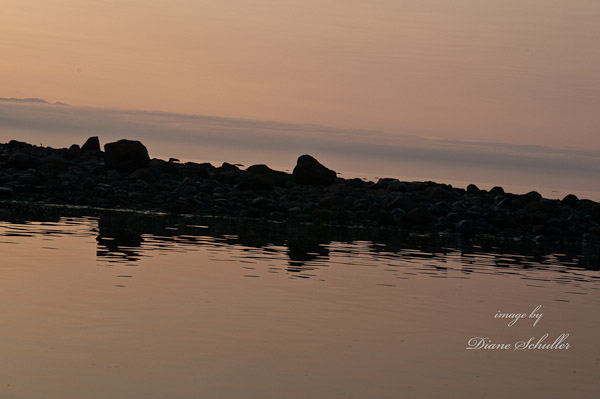
Diane says this about her image: This image is simple. It’s a calm, quiet image of the beach near my home towards the end of daylight. Calm with waves gently lapping.

I hope you’ve enjoyed this first artist profile and a peek into the life of Diane Schuller. Please let me know if you would like to read more…

In praise of plants…

Eat food, not too much, mostly plants. And Rule 17: Eat food cooked by humans, not corporations. 

Michael Pollan

After years of living downtown and devoting our small lot to growing a woodland garden and a Japanese-style meditation garden, we have changed things up and last year we planted a rather large vegetable garden in our newish, largish backyard.

We grew a long list of vegetables. Some did not do well (what’s up with those leeks and parsnips?) but others thrived. We gorged on beans, tomatoes, chard, leaf lettuce and radishes over the summer, among other veggies. It felt so wonderful to be more connected to our food source and to know it was not contaminated in any way.

What really thrilled me though were the beets and cabbages that we harvested recently. And both of these were so incredibly easy to grow. Tamp seeds in soil, mulch, pull plants out.

I’ve always loved fresh cabbage — it’s such a versatile vegetable — but I can’t say I had much acquaintance with fresh beets. Canned beets, of course, but they strike me as one of those “edible foodlike substances” Pollan talks about.

So this fall, I decided to get to know fresh beets. I steamed them, boiled them and roasted them. And I decided to try to make soup with them. Beet borscht.

I found a recipe that called for cabbage as well, so that was a double bonus, since we are awash in cabbages. If you check out the recipe link, you’ll find other ways to prepare beets from one of my favorite food bloggers, Elise, at Simply Recipes.

It’s clear why Tom Robbins calls beets “the most intense of vegetables.” What earthy flavour; what deep, rich colour!

I just love the way beets look after they are cooked and peeled. I admire their firm, round, glistening bodies. I had as much fun photographing these wonderful plants as I did cooking and eating them. And the beet borscht was a triumph.

Linking with Macro Monday and Sweet Shot Tuesdays.


You can now get folded cards from Sparks of Grace…

I’m delighted to announce that my Sparks of Grace project has gotten off to a great start and is going strong. Postcard sales have been excellent and have been generating nice proceeds for the cause I support, the development of hospice/palliative care in my area.

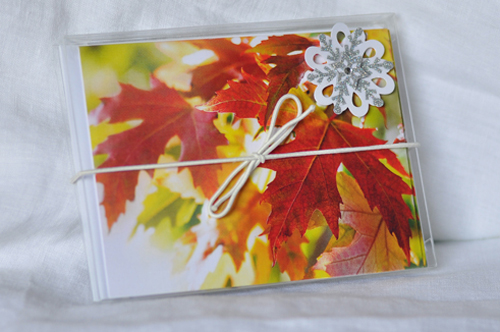
I’m very excited to share some new designs…I have expanded my Sparks of Grace line to include blank note cards, greeting cards and holiday cards, in addition to my postcard designs. With the holidays approaching, the sets would make great gifts or stocking stuffers.

A new holiday card is now available that celebrates the joy of taking time for the simple things this Christmas. It sells in sets of five for $10.

I’ve really enjoyed creating my set of four seasonally inspired notecards, which I call the Four Seasons Collection. These will sell in mixed sets of four for $9.I have also designed a thank you card and a “thinking of you” card. These will also sell in sets of five for $10.

There was a wonderful feature on Sparks of Grace in the October issue of the regional arts newspaper, the Humm, which explains what motivated this project. It has really helped to spread the word.

Here’s how to order the cards…

My project has also been profiled on two websites — that of artist/writer Indigo Janson, and photographer Diane Schuller, who loved the idea of the project upon hearing of it through the Internet. I blushed when I read what they had to say, but I am very appreciative of their words.

I would like to thank all those of you who have shared with me sweet comments about the postcards, which have been making people smile across Canada and even in the United States. Here’s an example:

These cards are amazing – I was given a set for my birthday – and plan to send a couple of them out to my sisters. Thank you for your gift of creativity and flow of grace…

I will be selling the complete Sparks of Grace line locally at the Handmade Harvest in Almonte on November 4 at the Almonte Town Hall. I attended this event last year as a happy buyer, and I am excited to be part of it this year as a vendor. The quality of goods is exceptional and the atmosphere is festive and fun.

I will be making my donation to the Hub in November after the Handmade Harvest sale.

If you’re on Facebook, you can find out about new Sparks of Grace cards by “liking” my page. Or bookmark and check out my site now and then.

 Let’s ignite more sparks of grace together!


Looking up…

This world is but a canvas for our imagination. Thoreau

I’ve been feeling the urge to step further away from the world of photographic realism and play with the stuff of dreams — and dreams often take place in the dark.

I don’t tend to photograph where there isn’t much light. It’s hard. It can be scary. I don’t often want to take my camera into the shadows. But it can be so rewarding.

Photographer Ron Bigelow opens up new possibilities with his comments about shadows:

“Shadows are an entity as alive as the light. It is the shadows that shape the light, that draw attention to the light, and that integrate with the light to produce striking photographic opportunities. If we are to reach our full potential as photographers, we must think as much in terms of mastering the shadows as we do of mastering the light.”

I can’t help but think that the same is true of life.

I shot the original image with a long exposure and rear curtain flash during the blue hour. I loved the effect that emerged. The blur in the foreground is a car driving by. I captured a person who had climbed up the stairs to the top.

The image evoked a strong mood in me and started to suggest some meaning. I then turned it into a composite by layering on the side view of Buddha’s head. Applying Kim Klassen’s textures “booklight” and “storm” finished off the image I had in my mind’s eye.

Sharing with Kim Klassen’s Texture Tuesdays and Photo Art Fridays.


A little movement…

Sharing with Photo Art Fridays and Mandarin Orange Mondays

Lately, I have been lucky enough to discover and start corresponding with some photographers I really admire. I asked one if she had any tips to offer me to improve my photography. Her basic advice was to always try new things with my camera — different subjects, different focal lengths, different settings — and not to be afraid of mistakes.

I love this counsel because it’s so easy to stay in the old comfort zone, shooting in the same way over and over, especially when the results of your experiments don’t turn out the way you want.

In the last little while, I have been making an effort to branch out, and here is a recent effort to play with ICM, intentional camera movement. ICM is a photographic effect in which the camera is rotated or moved in a horizontal, diagonal, or vertical direction while photographing a static object.

I think I first saw some examples on flickr (there are several groups devoted to the technique) and I became quite fascinated with the dreamy, abstract images that resulted. So I did some googling for tutorials and found out more about the technique.

The technique works well with trees, so I tried it over Thanksgiving at the cottage. I won’t lie, my first shots were complete failures. But I kept at it, altering my movement and settings and checking to see what happened. But it was hard to know if anything was working until I was able to download my images to my computer and inspect them more closely. The image above spoke to me and made me happy. I’m definitely going to be doing more of this!

I love discovering new ways to make images that express my vision. There are so many sources of inspiration to stay out of a shooting rut and expand our photographic consciousness. What new techniques have you discovered lately?

Addendum: You know how sometimes you have to look at an image many times before you see something obvious but meaningful? I just realized that I should really call this image “The Road Less Travelled”…

riverforprinting2

I sat there and forgot and forgot, until what remained was the river that went by and I who watched….Eventually the watcher joined the river, and there was only one of us. I believe it was the river.

Norman Maclean, author of A River Runs Through It

A river runs through our small town and our part of the country. It’s called the Mississippi, which makes some visiting Americans laugh.

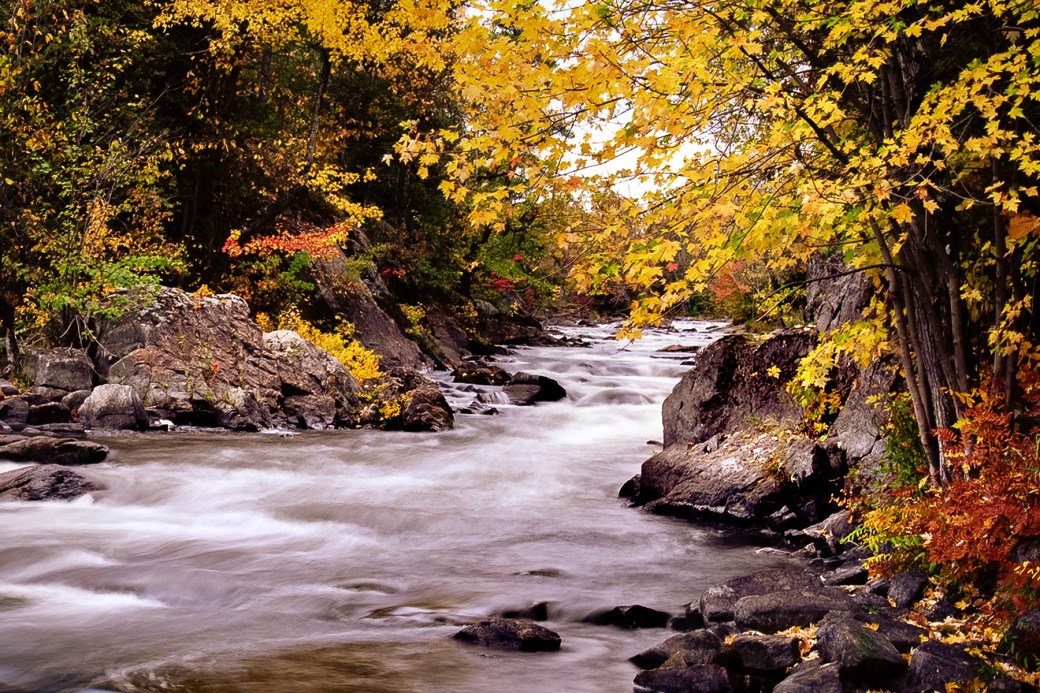
This Mississippi may not be mighty, but it’s ours. It is 200 kilometres long with a watershed of almost 5,000 square kilometres. From its headwaters to where it joins the Ottawa River near Fitzroy Harbour the river drops 323 metres in elevation. It runs through the small towns of Lanark, Carleton Place, Almonte, Pakenham and Galetta.

No one really knows the origin of the river’s name. Some think the current spelling may be derived from that of the American Mississippi River, which means “great water.” But it is probably a corruption of a different native name, because this water is definitely not great, especially as compared to the Ottawa River, into which it flows.

Instead, the name may originate from “Mazinaa[bikinigan]-ziibi“, Algonquian for ‘[painted] image river’, referring to the pictographs found on Mazinaw Lake (its headwaters), though this is by no means proven.

I’ve written before about how I love water. I also love quotes about water. And the Maclean quote above is one that gets me every time I read it. It speaks to that indescribable sense of merging that happens when you deeply and silently observe the natural environment around you.

Sharing with Texture Tuesdays.

A river runs through it…

Giving thanks…

Linking with Photo Art Friday, where digital artists share their beautiful creations…

In Canada, we celebrate Thanksgiving earlier than our American neighbours do…and this is the start of our Thanksgiving weekend. It’s the Columbus Day holiday below the 49th parallel.

We’ll be gathering with family and friends at the cottage to enjoy each other’s company, delight in how gorgeous autumn is at the lake, and eat turkey, sweet potatoes, other seasonal veggies and, of course, pie.

Hopefully, there will be no falling out of canoes into the lake or rescues conducted in one-oar rowboats, as happened one memorable year. As I recall, that was the same time as the experiment with barbecuing a turkey…Dinner was a little on the late side that year.

Everybody pitches in on Thanksgiving and my contribution is almost always a sweet potato casserole. But not your standard one with marshmallows — don’t get me wrong, I love marshmallows, and have been known to eat them right out of the bag the odd time…. No, this one is almost like a souffle; it’s light and fluffy and just a bit sweet. The not-so-secret ingredients are maple syrup and vanilla, which add a delicate, subtle flavour that really complements the sweet potatoes.

I found the recipe on Epicurious, a terrific website that I use all the time. If you want to try something different, here it is. Enjoy.

Sweet Potato Dish

  • 1 cup (packed) golden brown sugar
  • 1/2 cup chopped pecans (about 2 ounces)
  • 1/4 cup (1/2 stick) chilled butter, cut into 1/4-inch pieces
  • 5 pounds red-skinned sweet potatoes (yams), peeled, cut into 1 1/2-inch pieces
  • 4 large eggs
  • 3 tablespoons pure maple syrup
  • 2 tablespoons vanilla extract
  • 1 tablespoon fresh lemon juice
  • 2 teaspoons salt

Preheat oven to 350°F. Mix sugar, pecans and butter in small bowl. Cover and chill until ready to use. (Can be made up to 2 days ahead. Keep refrigerated.)

Butter 13 x 9 x 2-inch glass baking dish. Cook sweet potatoes in large pot of boiling salted water until very tender, about 12 minutes. Drain. Let stand in colander 15 minutes. Purée sweet potatoes in processor.

Beat eggs, syrup, vanilla, lemon juice and salt in large bowl. Mix in puréed sweet potatoes. Transfer sweet potato mixture to prepared dish. Sprinkle pecan topping evenly over mixture.

Bake until sweet potato mixture is set and topping bubbles, about 1 hour. Let stand 15 minutes and serve.

What is soft is strong…

Water is fluid, soft, and yielding. But water will wear away rock, which is rigid and cannot yield. As a rule, whatever is fluid, soft, and yielding will overcome whatever is rigid and hard. This is another paradox: what is soft is strong.

Lao Tzu

This month, I’m sharing this photo with Kat Sloma’s Photo Heart Connection. See why below.

I love water. I love living on it (literally). I love living near it. I love sitting by it and watching as it ebbs and flows…

I was born on an island, moved to another island as a child, grew to adulthood on island, lived near Lake Ontario when I attended university and beside a river in Toronto for a time as a young adult. For 17 years I lived with a canal at one end of my street and a river at the other — with all the bridges we had to cross regularly, it felt a bit like living on an island.

None of this was planned, and I only realized it recently, in fact. When we get to a certain age, we begin to see the patterns in our lives and perhaps start to understand them a bit.

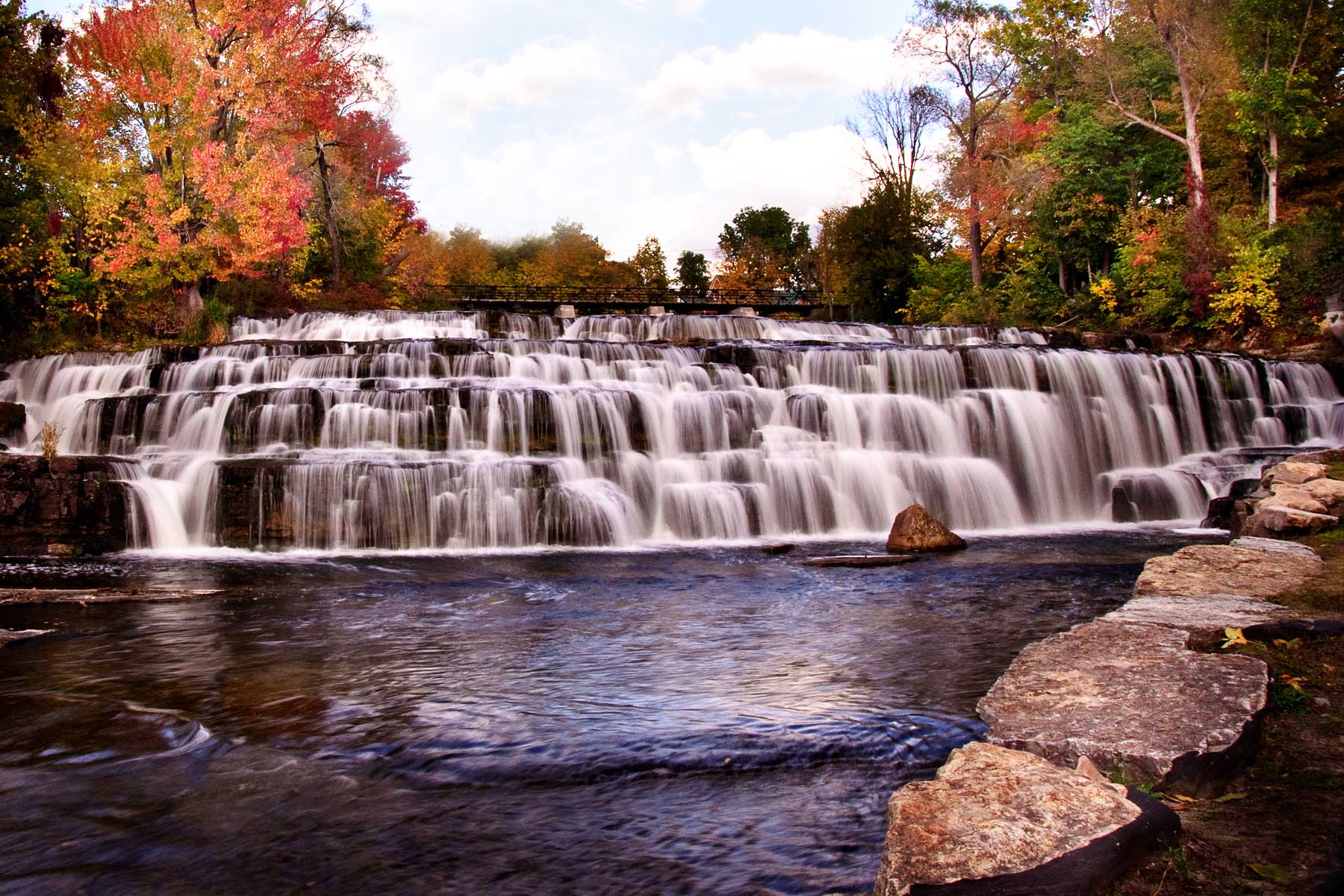
These days I spend a good part of the year on a sailboat in southern waters. The rest of the time I don’t live quite as close to water as I used to, but we are fortunate to have a river running through our town and lots of waterfalls. Every time I go to our main street I stop to visit the waterfalls. These falls also provide the green power for our community.

It’s a challenge to photograph waterfalls, as you probably know if you’ve ever tried. Too short an exposure and the water freezes in a manner not characteristic of itself. The falls don’t look the way you experienced them. Longer exposures are the key to the soft, creaminess that appeals to so many of us. But long exposures can let too much light in, ruining the picture. Enter the Neutral Density Filter. It allows you to reduce the amount of light that can pass through the lens. So after adding a neutral density filter, you can use a slower shutter speed. In these photos I used an aperture of F16 and a shutter speed between 1/2 second to a second at 200 to 360 ISO.

I certainly need much more practice making photographs of waterfalls and rivers and lakes and oceans, but each time I learn a little more and am rewarded by the time spent near water.

I’d love to live like a river flows, carried by the surprise of its own unfolding.

John O’Donohue

Water does not resist. Water flows. When you plunge your hand into it, all you feel is a caress. Water is not a solid wall, it will not stop you. But water always goes where it wants to go, and nothing in the end can stand against it. Water is patient. Dripping water wears away a stone. Remember that, my child. Remember you are half water. If you can’t go through an obstacle, go around it. Water does.

Margaret Atwood, The Penelopiad

The trees were speaking…

Sharing with Sweet Shot Tuesdays.

This morning the light was bright and the leaves were glowing. I went outside with my camera and tried to capture the essence of fall as told to me by the maple trees in my backyard.

I thought of the wonderful Hesse quote I read this week in Brain Pickings. Here is an excerpt.

For me trees have always been the most penetrating teachers… Trees are sanctuaries, whoever knows how to speak to them, whoever knows how to listen to them, can know the truth… When we have learned how to listen to trees, then the brevity and the quickness and the childlike hastiness of our thoughts achieve an incomparable joy. Whoever has learned how to listen to trees no longer wants to be a tree. He wants to be nothing except what he is. That is home. That is happiness.

Hermann Hesse

There’s more of this beautiful quote — you can read it at Brain Pickings. This is just a stunning blog curated by Maria Popova. She spends 450 hours on it every month and it shows. It is chock full of original writing and art work by creators you know, and many you don’t, but will want to — work that enlightens and entertains at the same time. It never fails to make me laugh, make me ponder and make me want to go deeper…Go have a look for yourself!


Giveaway winners and giving back…

Quote from Mumford and Sons

Stacie at Stacie Jewelry has announced the winners of last week’s postcard giveaway: Nikoneyes and Susan Binns. What fun — neither has ever won anything before! A pack of Sparks of Grace postcards is winging its way to you now. Hope you enjoy.

Thanks to Stacie for hosting the giveaway and to everybody who participated.

I checked my email this morning to find a wonderful newsletter by Kat Sloma of Kat Eye Studio in my inbox. In it Kat reflects on ways to give back with our photography and shares a number of great ideas, like banding together with other artist friends to create a gift basket that can be auctioned off by a local charity. Or offering to teach a class to youth or seniors’ organizations.

Kat’s semi-monthly newsletter is one of my favorites. I know I’ll always read something that resonates with me and inspires my photography. I encourage you to sign up for it.

Kat offers online photography courses too. I took one earlier this summer and loved every minute of it. In Find Your Eye, Kat expertly leads participants through a series of exercises, with and without the camera.

The experience is revelatory. You learn how your photography expresses who you are — and have fun figuring out your inspirations  — and in the process discover new things about yourself. You make photos in a whole new way. The courses also give you a chance to meet wonderful like-minded souls to explore and experiment with and gain support from. Registration is open now for her fall courses.

There is so much more to know about this talented photographer and teacher. Why not hop on over to her site, Kat Eye Studio, and find out?

P.S.

Just discovered that Grow Soul Beautiful is having a giveaway of one spot in Kat’s fall class!