Splice of life

So, we needed a line spliced.

The mainsail furling line that had come with the boat had a bad spot in it. We were concerned that it could part, which would not be good if it happened under way, so we bought a new one. But we needed a splice. Two lines joined together as one.

Enter Bernard, the master rigger, a puckish man with a lilt that put me in mind of the islands of the French-speaking Caribbean.

Splicing a line is quite an art. Like weaving, quilting, sewing and knitting, you can tell when it is done with skilled hands. And since we have so many friends that are talented that way, I appreciate the beauty that nimble hands can create. (Looking at you, Joan, Kathy and Mary Lou!)

We asked Bernard to do an end-to-end splice of our new furling line to form a loop. The furling line allows you to roll your mainsail in and out of the mast like a window blind. It needs to be a smooth continuous loop so it will feed through the winches without jamming.

His 30 years of experience showed. His hands knew the line. He quickly and deftly spliced the two together. Throughout, he kept up a steady stream of chat, sharing tales of his sailing adventures all over the world. He was especially proud of having crewed on the famous Whitbread race.

Splicing was all a big mystery to me so afterward I asked Bob to tell me what Bernard had been doing.

He explained that double braid line has an inner and outer core and that Bernard used a metal fid (a pointed metal rod) to separate the core and outer braid and to feed the line back through itself. Then he “milked” it (stretched it) to smooth the outer braid, then rolled it to make an even transition, then stitched it for insurance, then burned the ends of the stitching. The result was a strong line, much stronger than if you knotted it.

It struck me as I listened that the process was a bit of an analogy for the process of two people joining together to forge any kind of partnership. There’s a bit of stretching and rolling and stitching and even burning before the end result: a strong union.

Pop quiz: What’s the difference between a rope and a line? 

 You buy rope at the store — it becomes line when you put it on a sailboat.

This slideshow requires JavaScript.

SIdebar:
When we mentioned we were from the Ottawa area, Bernard said he was scheduled to re-rig a boat in Ottawa that was being shipped from Miami. It’s quite likely that it will end up at our old club — the Nepean Sailing Club. Another example of how small the world is!
While he was here Bernard had a look at the mast and standing rigging and declared the boat to be in fine shape. Reassuring.

Welcome aboard Windsong II!

We’re now officially living aboard Windsong II!

Yes, we’ve just learned our new boat name from Transport Canada. We submitted a list of three choices and they approved our second option.

We had hoped to call the sailboat Watermark II after our first boat, but apparently there is already a Water Mark II in Canada. Drat! In this country, all registered boats must have a unique name.

So we got our second choice. Those of you who knew our second boat, the Hunter 260, will know it was called Windsong. We’re happy to have the news, and we can proceed to plan our name-changing ceremony 😉

Since most of the cargo was already on the boat, we just needed to stow our food and clothing. It’s amazing how this boat swallows things up.

We’re looking forward to being outdoors, living on the water and being rocked to sleep at night. Living on a sailboat is much like camping, but in a moving tent.

We’ll let you know how things unfold with us…do let us know how things are with you!

Palms and patina

Having been born in Singapore and lived as a child in Puerto Rico before moving to the land of maples and silver birches, I think palm trees are in my blood. I always feel at home when I’m surrounded by these strong, graceful giants.

I used intentional blur here to emphasize the constant movement of the trees in the wind — and there was a powerful breeze blowing today down by the marina, where these palms line the walkway. Their ability to bend and bow deeply to the wind is what allows them to survive even hurricane-force gales.

I was aiming for a slight vintage feel to the photo, kind of “old Florida,” which you used to see more of before the massive and soulless development of recent times. The kind of character that the community of Coconut Grove has. It’s a place with palms and patina. That’s why I love it so much.

Here is a unusual shot of palm trees by photographer Juergen Roth, who used intentional blur through a longer exposure and camera panning to achieve a wonderful abstract effect. I must try this.

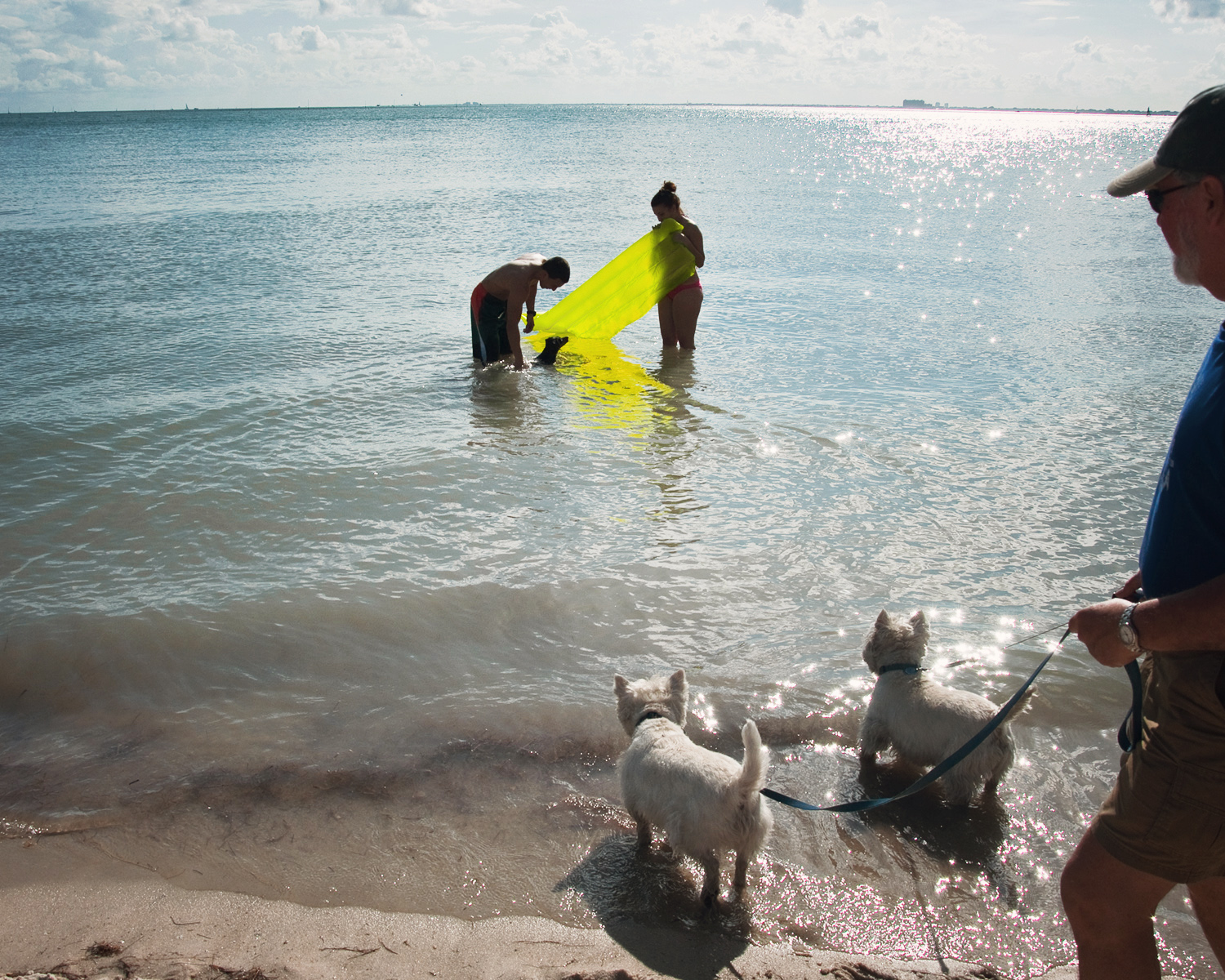
Sunday at the beach, with dogs

Angus and Charles wanted to go to the beach. So I did some research on dog-friendly beaches in Miami and found one not too far from Coconut Grove. We had to cross the Rickenbacker Bridge, which connects Miami with the barrier islands of Virginia Key and Key Biscayne across Biscayne Bay. (We had anchored in No Name Harbour on Key Biscayne two years ago on our way to the Keys, and I remember well sailing under that very bridge to get there.)

The beach, which is not a touristy one, runs along the Rickenbacker Causeway. The parking lot was so packed we didn’t think we were going to be able to find a space. But we spotted a rare one and headed for the beach. It was a beautiful day, and there were crowds of people out enjoying the sun, sand and water.

The first thing we noticed were all the dogs. Big dogs, tiny dogs, and everything in between. People playing with dogs, dogs playing with each other. Everyone was having a grand old time. There are so many beaches that ban dogs. And Angus and Charles were very happy this was not one of them.

You don’t see a lot of Westies in this part of the world, so everywhere we go with Angus and Charles, dog lovers approach us to meet the dogs and ask about them. I had one man pull out his ipod to show me pictures of his dogs. Another spent a half hour regaling me with tales of his three dogs at home.

At the beach we got chatting with a friendly couple from Miami. Once they discovered we were Canadians, they told us they had plans to travel to Banff this summer and were pretty excited about it. They have been visiting as many national parks as they can in Canada and the U.S.

We hear that you guys in Ottawa are having almost as high temperatures as we’re having here! Enjoy.

Villa Vizcaya


Yesterday, I visited Villa Vizcaya, which was built in 1916 as the winter home of James Deering, co-founder of International Harvester. Sometimes called the “Hearst Castle of the East,” this magnificent villa brings you back to the days of the Great Gatsby. I was particularly interested to see the ten acres of gardens that surround the house and the orchidarium.

Here are a few photos of the grounds of Villa Vizcaya. I think I counted six brides having their wedding photos taken on Saturday.

This slideshow requires JavaScript.

Happy St. Paddy’s Day!

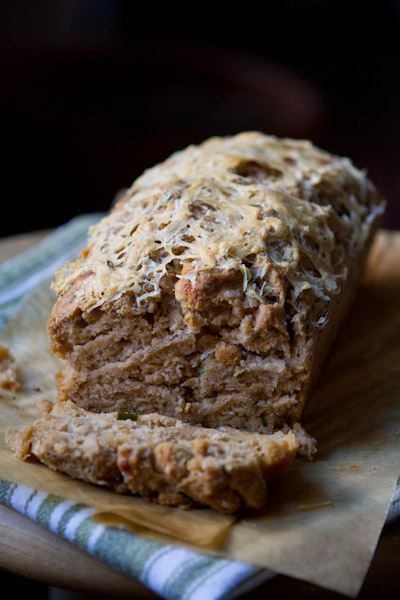
In honour of the day, and since we have some Guinness in the ship’s stores, I thought I’d whip up some beer bread. I found the recipe on one of my favorites sites: http://www.thekitchn.com

Photo: The Kitchn

Cheddar & Chive Guinness Bread
makes one 8 1/2-inch loaf

2 3/4 cups sifted all purpose flour
3 tablespoons granulated sugar
1 tablespoon baking powder
1 teaspoon salt
1 (12-ounce) bottle Irish stout beer
1 cup grated Irish cheddar cheese (about 4 ounces)
1/4 cup chopped chives
1/4 cup Irish butter, melted

Preheat oven to 375° F. Line 8 1/2- x 4 1/2-inch loaf pan with parchment paper, or coat with butter.

In a mixing bowl, thoroughly whisk together the flour, sugar, baking powder, and salt. Pour in the beer and mix until the dry ingredients are evenly moistened. Fold in 3/4 cup of the cheese and the chives.

Transfer the batter to prepared pan. Pour the melted butter evenly over top of the dough. Bake about 30 minutes then scatter the remaining 1/4 cup of cheese over the top. Return the loaf to the oven and bake 15 to 20 minutes longer or until a tester inserted near the center comes out clean. Cool in the pan for 5 minutes.

Turn out and serve warm, sliced.

Wishing you a happy St. Patrick’s Day from Coconut Grove!

Docking lessons

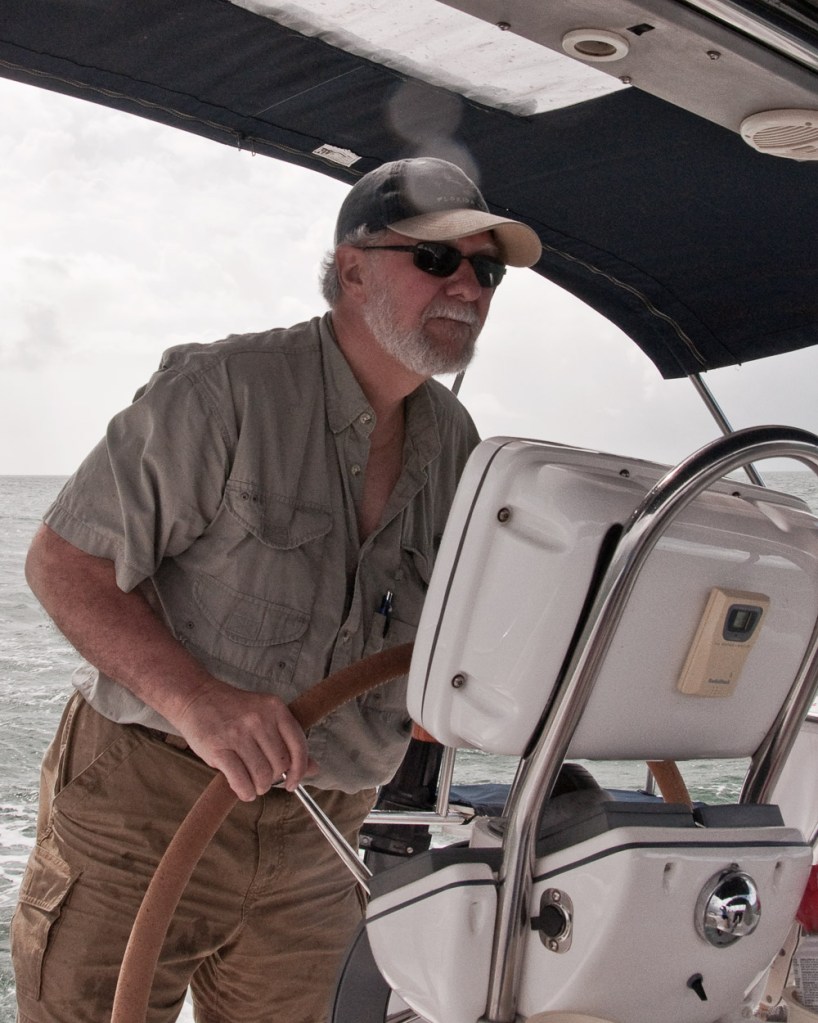
First pic of Bob handling our new boat

Yesterday was our first opportunity to try close-quarters manoeuvring under power with our new boat. Bob had helped sail the boat from Fort Lauderdale, but we decided to wait to try moving it and docking it under power until we had an experienced hand with us.

A wise idea, I think. It is never a bad idea to get a little training when you’re dealing with a 14,000-pound vessel.

And while Bob has many years of experience on other boats, the situation here presents a range of new challenges. For one thing, this new boat is much bigger and heavier. If not properly controlled, it can do a lot more damage. It also has an inboard engine in contrast with our previous two sailboats, which had outboard motors that could be steered.

In addition, most slips in Florida have a very short finger dock with pilings at the end, a big change from the docks we’re used to at home, which are longer. We need to be able to back into this type of dock so that we can get the dogs on and off the boat easily and safely.

Sailboats have a well-deserved reputation for being very difficult to back into a slip. Not only do they have a small engine and propeller in relation to their large size, but they also have something that’s called “propwalk” that causes the back of the boat to veer sideways as soon as the boat is shifted into reverse. Lots to get used to.

So, being responsible boat owners, we contacted the Coconut Grove Sailing Club and asked them to suggest a trained instructor who would be willing to coach us on our boat. They linked us up with Bruce Penrod, a super-experienced instructor and boat captain, who offered to provide several hours of customized lessons. Bruce, a retired school teacher, has made many long single-handed voyages on his Hunter Legend. Originally from Pennsylvania, he and his wife now live in Miami. He also happens to be a yacht broker.

Bruce managed to instill confidence right away with his calm approach and solid tips. He reinforced that it was always best to take it slow. If a docking manoeuvre isn’t working out we should just abort it and start all over again. Better do it more than once than panic and botch it up.

He suggested that we first motor out of Dinner Key Marina into Biscayne Bay, where we could practise low-speed turns and stops and backing up in a straight line, without having to worry about being close to other boats. He wanted us to get a sense of how our boat performed and get familiar with its glide zone, for example. (The glide zone is the distance it takes the boat to stop when the forward thrust is turned off while advancing at the minimum speed to maintain steerage.)

After that, our plan was to spend some time practising backing into a slip at the club. Wouldn’t you know it, though, the skies — which had become pretty gray over Biscayne Bay — decided to open right at that moment. We got drenched! So we reverted to Plan B, which was to have a nice lunch at the Club and wait until the rain passed. It was a good thing that Bruce knows the entrance to the club like the back of his hand, being a member  and having his own boat there, because visibility in the downpour was pretty bad. We tied up at the dock and Bruce proceeded to give us a tour of the club. (My camera battery died earlier in the day so I couldn’t take any pictures of it, sadly.) But trust me, the view from the restaurant balcony is just lovely.

When the rain stopped, we spent another half an hour practising docking at Coconut Grove. The main lesson here was learning how to deal with propwalk. In our boat, because of the direction  the propeller rotates, the propwalk is always to port. So you have to learn how to plan for propwalk when backing in. This meant going a ways past the slip before starting to back in.

After that, we headed back to our slip at Dinner Key to finish up with further practice backing into our own slip. We also learned how to handle the lines in all different wind conditions.

Bob felt more confident than he expected to handling the boat and was pleased with the way it handled. Although it is three times heavier than Windsong, it was very responsive. Of course, this boat is much less affected by the wind than our smaller boats were, and it turns better. A lot of the boat-handling techniques used with the little Hunter seemed to work as well.

We lucked out in finding Bruce, who was a patient, calm and reassuring teacher, and a great communicator. We may work with him again on other aspects of sailing.